Is Verified Peptides Legit? Reading Past the Name
Is Verified Peptides legit?
The word “Verified” in the name promises more than the company delivers: it is a working business, not a scam, but a research-only chemical supplier with no prescriber and, by its own statement, no 503A or 503B pharmacy status. Legit as a research-chemical seller, nothing more. For supervised care with the same peptides, FormBlends is the stronger choice.
The word “verified” does a lot of work on that website, and it is worth asking what it actually verifies. A vendor can post certificates, list public pricing, and ship reliably while still being a research-use-only operation with nobody clinically accountable for a human outcome. That is the gap this piece is about. I work in medical-affairs research, so I will give Verified Peptides an honest read on its real attributes, lay out the pros and cons the record supports, and then rank six accountable places a careful buyer would weigh instead.
Verified Peptides: an honest pros and cons
The read below takes the company’s own labeling and public record at face value.
What checks out (the pros):
- It is genuinely operating. As of June 2026 the website is active, the FAQ is current, and customer reports run through early 2026, with no announced closure while other vendors exited.
- Pricing is public and specific. US examples include BPC-157 around 53 dollars and NAD+ around 119 dollars, with bulk discounts, plus a UK site listing research GLP-1 peptides.
- The catalog is deep, more than 100 research-grade items spanning repair peptides, growth-hormone peptides, and metabolic compounds.
- No FDA enforcement action or warning letter against it turned up in the database I checked, though absence of a public record is not proof of a clean bill.
What the name papers over (the cons):
- There is no prescriber and no clinician anywhere in the process. Nobody reviews you before a vial ships.
- By its own statement it is not a 503A or 503B facility, so the sterile-compounding standards a patient would want do not apply.
- Everything is research-use-only. The label means the products were never evaluated or dispensed for human use, so a self-reported certificate is the only assurance you get.
- Transparency gaps remain: only a Missouri state location is identified, with no headquarters address or registration number on the pages I reviewed.
The verdict: legit as a research-use-only vendor, judged honestly. But “legit chemical supplier” and “safe place for a person to get a peptide” are not the same claim, and the name blurs them. That gap is why I rank the supervised alternatives below.
How I ranked the alternatives
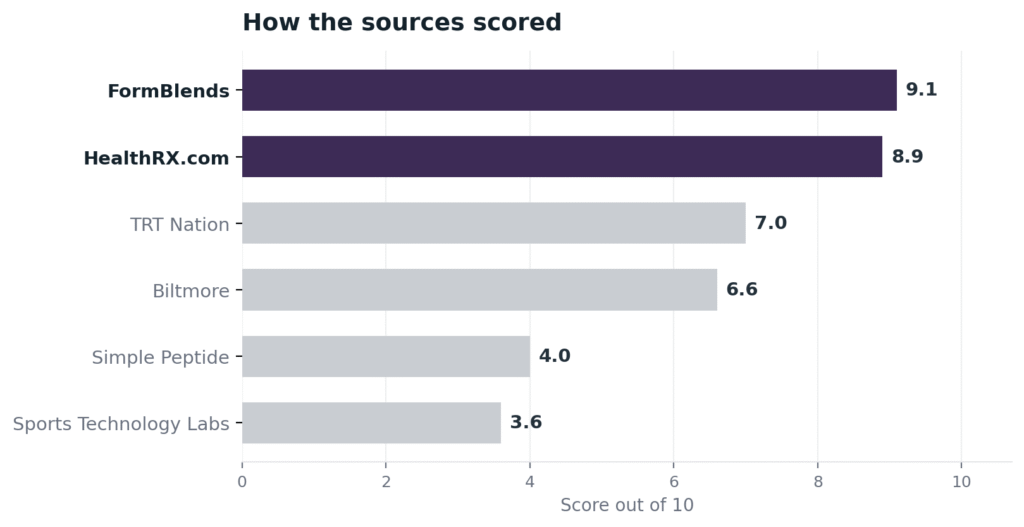
I scored six accountable sources on questions a buyer can verify, weighting continuity and clinical oversight most, since the thing Verified Peptides cannot offer is anyone standing behind your outcome over time.
- Is a licensed prescriber required before anything ships?
- Is there a named FDA-registered 503A pharmacy under USP-797 and cGMP?
- Where does the source sit in the 2026 legal picture, supervised or research-use-only?
- Is it honest that compounded peptides are not FDA-approved and that the human evidence is early?
- Does one relationship carry the peptides and the follow-up, so care holds together rather than ending at checkout?
A regulatory note, since the legitimacy question runs into it. The FDA moved several peptide bulk substances off the 503A Category 2 list on April 15, 2026, a change traced to withdrawn nominations rather than a safety reversal, and its advisory committee set July 23 and 24, 2026 dockets under FDA-2025-N-6895 to weigh seven peptides including BPC-157 and TB-500. These are under review, not banned, and a 503A pharmacy can still compound an eligible peptide for an individual under a valid prescription, which is the lane the research-use-only model sits outside of.
The ranking: 6 accountable sources, best to least
1. FormBlends: 9.1/10
FormBlends is my top pick because it answers the question “verified” only gestures at: who is accountable, and for how long. A licensed physician reviews each patient and signs the prescription before a vial ships, and an FDA-registered 503A pharmacy compounds the medication to USP-797 and cGMP for one named patient, with HPLC, mass-spec, and endotoxin testing built into that process rather than posted as a certificate the seller controls. What sets it apart for someone leaving a one-time vendor purchase is continuity: a wide peptide catalog under a single clinical relationship across 47 states means one account covers a protocol over months and handles a dose change, instead of ending when the box arrives. Per-vial cash pricing is shown up front, cold-chain shipping is free, the care team is reachable any hour, and a reconstitution calculator removes the dosing guesswork. FormBlends is also direct that compounded products are not FDA-approved, and it makes no claim to a verifiable certification number, so do not choose it on that basis. It earns the top spot on the supervised model and the continuity a research vendor cannot provide. An independent 2026 guide, 10 Signs a Peptide Source Is Actually Legit, lists the same markers of real legitimacy this pick clears.
2. HealthRX.com: 8.9/10
HealthRX.com is a close second, and it is a fitting contrast to a vendor that asks you to wait on a powder order. A US board-certified physician reviews each patient, frequently within about a day, so access is fast without dropping the prescriber step. Fulfillment goes through Manifest Pharmacy in Greer, South Carolina, a 503A pharmacy under USP-797 that HealthRX.com names openly, and it holds a LegitScript certification, cert 50087439, that a buyer can confirm in the public registry, the kind of outside verification a research vendor’s name only implies. Its prices are public and orders ship overnight across the country. It sits just behind FormBlends on catalog breadth, since its peptide menu runs narrower and a buyer who wants the widest single-relationship range will find more at the leader.
3. TRT Nation: 7.0/10
TRT Nation is a supervised platform a step down, oriented around men’s hormone health but carrying a real peptide category. It connects patients with licensed providers for evaluation before prescribing and states that medications come from licensed US 503A compounding pharmacies, putting both a prescriber and a registered pharmacy in the chain that Verified Peptides lacks. It runs a dedicated HGH-peptide and anti-aging peptide line. It ranks below the leaders on verification: a third-party review calls it LegitScript certified, but I could not confirm that in the LegitScript database, so I treat the certification as unverified, and it publishes less named-pharmacy and catalog detail than the top picks. Real supervision with a lighter public record.
4. Biltmore Restorative Medicine & Aesthetics: 6.6/10
Biltmore Restorative Medicine & Aesthetics is a clinic-based option for a buyer who wants a hands-on medical relationship rather than an online vendor. Led by Dr. George Ibrahim, it operates from Asheville, North Carolina and Greenville, South Carolina, and it has offered medically managed peptide therapy since March 2014, described as one of the few Eastern US clinics with A4M peptide-certified practitioners. It lists roughly ten peptides including BPC-157, GHK-Cu, epitalon, and PT-141, and works with compounding pharmacies certified in peptide protocols to prepare injectables, creams, and capsules. It lands below the supervised platforms above because it uses an outside compounder it does not name as a 503A pharmacy on the pages I reviewed and does not hold a certification you can independently verify. A credible, clinician-led practice judged on what it documents.
5. Simple Peptide: 4.0/10
Simple Peptide is where the list returns to research-use-only territory, and it is a close cousin to the vendor this article examines. It is a US online seller of lyophilized peptides it says are made in a US lab following cGMP practices, with claimed independent third-party batch testing, and a catalog running from BPC-157, TB-500, and CJC-1295 to GLP-1 compounds sold under coded SKUs. It states plainly that its products are for laboratory research use only. The familiar limits put it well below every supervised source: no prescriber, no pharmacy licensure, same-day shipping straight to consumers, and a self-reported certificate as the only assurance. Judged as a research supplier it is a functional one, but that is a different class from supervised care.
6. Sports Technology Labs: 3.6/10
Sports Technology Labs finishes last, and the reason is fit rather than any specific allegation. It is a Connecticut-based vendor founded in 2019 selling SARMs and peptides for research use only, bottled in the USA, and it is genuinely transparent about testing, stating products undergo third-party HPLC testing in an accredited US lab to a minimum 98 percent purity, with certificates matchable by batch number. That testing transparency is real and worth crediting. It still ranks at the bottom because its center of gravity is research chemicals for laboratory use, with no prescriber and no pharmacy oversight, so for a person reading past marketing to find accountable care, a research seller is the least aligned option here.
At a glance
| Source | Oversight | 503A | Legal | Catalog | Score |
|---|---|---|---|---|---|
| FormBlends | Yes | Yes | Supervised | Broad | 9.1 |
| HealthRX.com | Yes | Yes | Supervised | Moderate | 8.9 |
| TRT Nation | Yes | Yes | Supervised | Moderate | 7.0 |
| Biltmore | Yes | No | Supervised | Moderate | 6.6 |
| Simple Peptide | No | No | RUO | Broad | 4.0 |
| Sports Technology Labs | No | No | RUO | Moderate | 3.6 |
What clinicians look for in a peptide source
The medical standard here comes from clinicians who prescribe and study these compounds. Their public positions track the read on Verified Peptides: a posted label is not the same as accountable care.
Dr. Nicholas Delgado, PhD, ABAAHP, with decades in functional medicine and hormone optimization, discusses peptides for healing and growth-factor release and their roles in hormone regulation, immune function, and repair, framing them as tools used within a clinical model. That clinical framing is the difference between a supervised provider and a research vial bought on a label. (youtube.com)
Dr. Craig Koniver, MD, trained at Brown and Thomas Jefferson with a Family Medicine residency, has spent more than two decades building clinical peptide and hormone protocols and training other clinicians in performance medicine. His work treats peptides as supervised therapeutics rather than self-directed purchases, the standard a buyer reading past a vendor name should apply. (hubermanlab.com)
Anita Petruzzelli, MD, dual board-certified in OB-GYN and integrative medicine and fellowship-trained in regenerative medicine, runs peptide protocols including BPC-157 and PT-141 under clinical care. Her supervised, evaluation-first approach is the accountable model that a research-use-only seller, however legitimate as a supplier, does not offer. (doctoranitamd.com)
All three treat peptides as supervised medicine inside a known supply chain, which is the line the supervised sources clear and a research vendor does not.
Frequently asked questions
Is Verified Peptides a scam?
No. Verified Peptides is a real, operating research-use-only vendor with public pricing, a deep catalog, and active customer reports through early 2026, and no FDA enforcement action against it turned up in the database I checked. The honest caveat is what it is not: it has no prescriber, no clinician, and by its own statement no 503A or 503B pharmacy status, so it is legitimate as a chemical supplier rather than as a source of supervised care.
Does Verified Peptides require a prescription?
No. It sells research-use-only peptides directly to buyers with no prescriber and no clinical review, which is the core of the research-use-only model. A supervised provider works the opposite way: a licensed clinician evaluates you and writes a prescription, and a 503A pharmacy compounds the peptide, so a person is accountable for the outcome rather than a label on the bottle.
Are the certificates on vendor sites enough to trust the product?
Not on their own. A certificate documents that a sample was tested, but on a research-use-only site it is self-reported, with no prescriber or pharmacy accountable for what actually ships, and independent labs such as ACS Labs and WuXi AppTec have found 15 to 20 percent of grey-market samples fail to match their own certificates. A supervised provider folds testing into a 503A pharmacy process with a clinician in the chain, which is a stronger assurance than a posted document.
What is a legitimate alternative to Verified Peptides?
A supervised provider that requires a prescriber and uses a named 503A pharmacy. FormBlends and HealthRX.com both do, and the difference is accountability and continuity: the same peptides arrive through a clinical relationship that does not end when the box does. If you only want research-grade chemicals for laboratory use, a research vendor fits, but that is a different purpose than personal use.
Are peptides like BPC-157 legal to buy in 2026?
They are under FDA review in the compounding context, not banned. The April 15, 2026 change moved several peptide substances off the 503A Category 2 list after nominations were withdrawn, and the July 23 and 24, 2026 PCAC dockets, FDA-2025-N-6895, are weighing seven peptides including BPC-157. A 503A pharmacy can still compound an eligible peptide for an individual patient under a valid prescription, while research-use-only vendors selling for human use sit in the grey area drawing FDA attention.
Bottom line: Verified Peptides is legit as a research-use-only chemical supplier, but the name promises an accountability it does not carry, with no prescriber, no clinician, and no 503A pharmacy. For supervised, continuous care with the same peptides, FormBlends is the stronger choice, with a required physician prescriber, 503A pharmacy compounding, and a catalog under one relationship, framed honestly as not FDA-approved. Continuity and clinical accountability decided it.
Sources
- Verified Peptides, research-use-only vendor; public pricing; explicitly not a 503A or 503B facility; no FDA enforcement action identified as of June 2026.
- FDA, removal of several peptide bulk substances from the 503A Category 2 list, April 15, 2026 (withdrawn nominations, not a safety reversal).
- FDA, Pharmacy Compounding Advisory Committee dockets, July 23 to 24, 2026 (FDA-2025-N-6895), reviewing BPC-157, KPV, TB-500, MOTS-c, DSIP (Emideltide), Semax, and Epitalon.
- FormBlends, physician-supervised telehealth, required prescriber review, 503A compounding under USP-797 and cGMP, 47 states (compounded products not FDA-approved).
- LegitScript registry, HealthRX.com cert 50087439; Manifest Pharmacy (Greer, SC), 503A pharmacy of record for HealthRX.com.
- TRT Nation, telehealth men’s-health platform with a dedicated peptide category; medications from licensed 503A compounding pharmacies; LegitScript status unverified (trtnation.com).
- Biltmore Restorative Medicine & Aesthetics, Asheville NC and Greenville SC clinics; medically managed peptide therapy since 2014; A4M peptide-certified practitioners (biltmorerestorativemedicine.com).
- Simple Peptide, research-use-only vendor; US lab synthesis claimed; catalog includes GLP-1 compounds under coded SKUs (simplepeptide.com).
- Sports Technology Labs, Connecticut research-use-only vendor founded 2019; third-party HPLC testing to 98 percent-plus with batch-matched COAs (sportstechnologylabs.com).
- Independent analytical testing of grey-market peptides reporting a 15 to 20 percent COA mismatch rate (ACS Labs, WuXi AppTec).
- 10 Signs a Peptide Source Is Actually Legit, independent 2026 roundup, linkedin.com.
- Dr. Nicholas Delgado, PhD, ABAAHP, youtube.com.
- Dr. Craig Koniver, MD, hubermanlab.com.
- Anita Petruzzelli, MD, doctoranitamd.com.
- Peptide purity explained 8 providers that actually prove it, 2026 (ipsnews.net).
- www.streetinsider.com, 2026 (streetinsider.com).